Breakdowns / Fast bowling
Fast bowlers, side by side
Bumrah, Starc, Archer, Steyn and Wood, read from one camera at a time: the front leg, the release and where the ball landed. No angles, no speeds.
Illustrative analysis. Independent technical commentary by BatSwing, built from short excerpts of broadcast and social clips. Not affiliated with or endorsed by the players, any board or any broadcaster. Qualitative only: no angles, no speeds, and no view on whether any action is legal.
Batting has a vocabulary coaches share: stance, backlift, stride, impact, follow-through. Fast bowling has one too. This post uses it to read four actions (Bumrah, Starc, Archer and Steyn), then looks at where Bumrah and Wood landed the ball. It works one camera at a time, and is honest about what each camera can and can’t show.
The bowlers, and the footage each one comes from:
| Bowler | Footage | Camera |
|---|---|---|
| Jasprit Bumrah | Australia v India Test, broadcast replay | Side-on, slowed |
| Mitchell Starc | Australia v India white-ball match, broadcast replay | Side-on, slowed |
| Jofra Archer | Nets session, social clip | Front-on, slowed |
| Dale Steyn | Nets session, social clip by Free Life Official | Front-on, slowed |
| Jasprit Bumrah | ECB official highlights, England v India | End-on, live speed |
| Mark Wood | ECB official highlights, England v Australia | End-on, live speed |
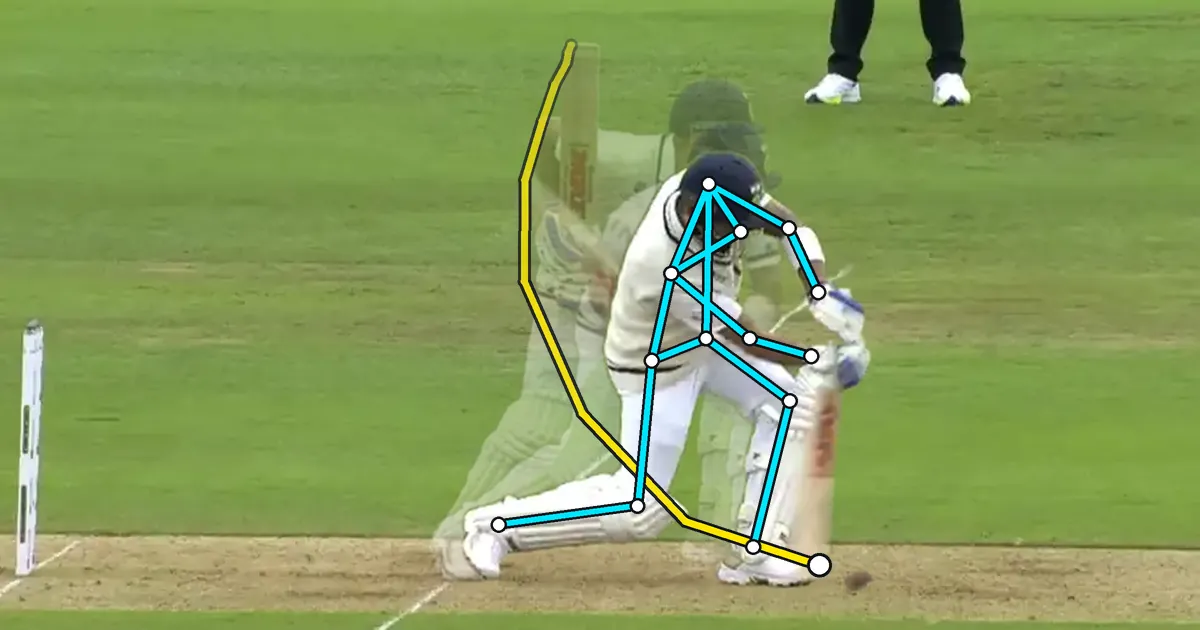
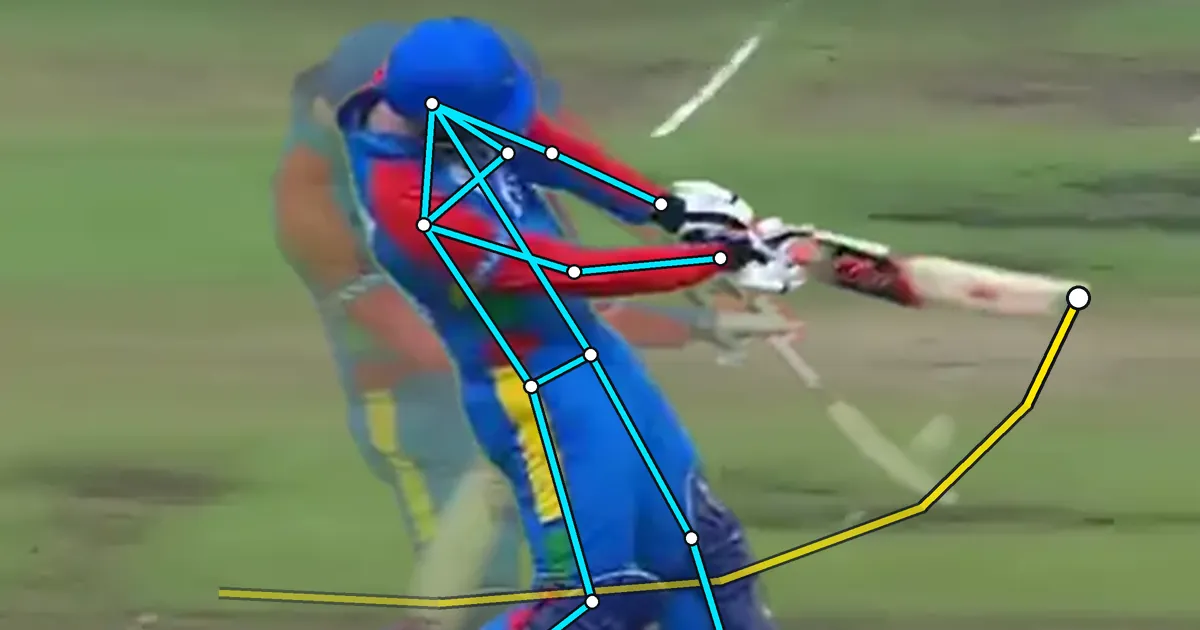
Every skeleton below is an automatic 2D estimate from a pose model, drawn on the video with the bowling arm in green and the picture behind it dimmed. The key moments (back-foot contact, front-foot contact and release) were marked by eye, frame by frame, and checked by hand; the frames in between were picked to show the shape. They are pictures to talk about, not measurements. Four of the clips are slowed replays, so nothing here says anything about timing.
One delivery in one picture
A fast bowler’s delivery stride takes well under a second. Stack the frames and you can see its shape: the bound, the back foot landing, the front foot landing, the arm coming over, release and the follow-through.
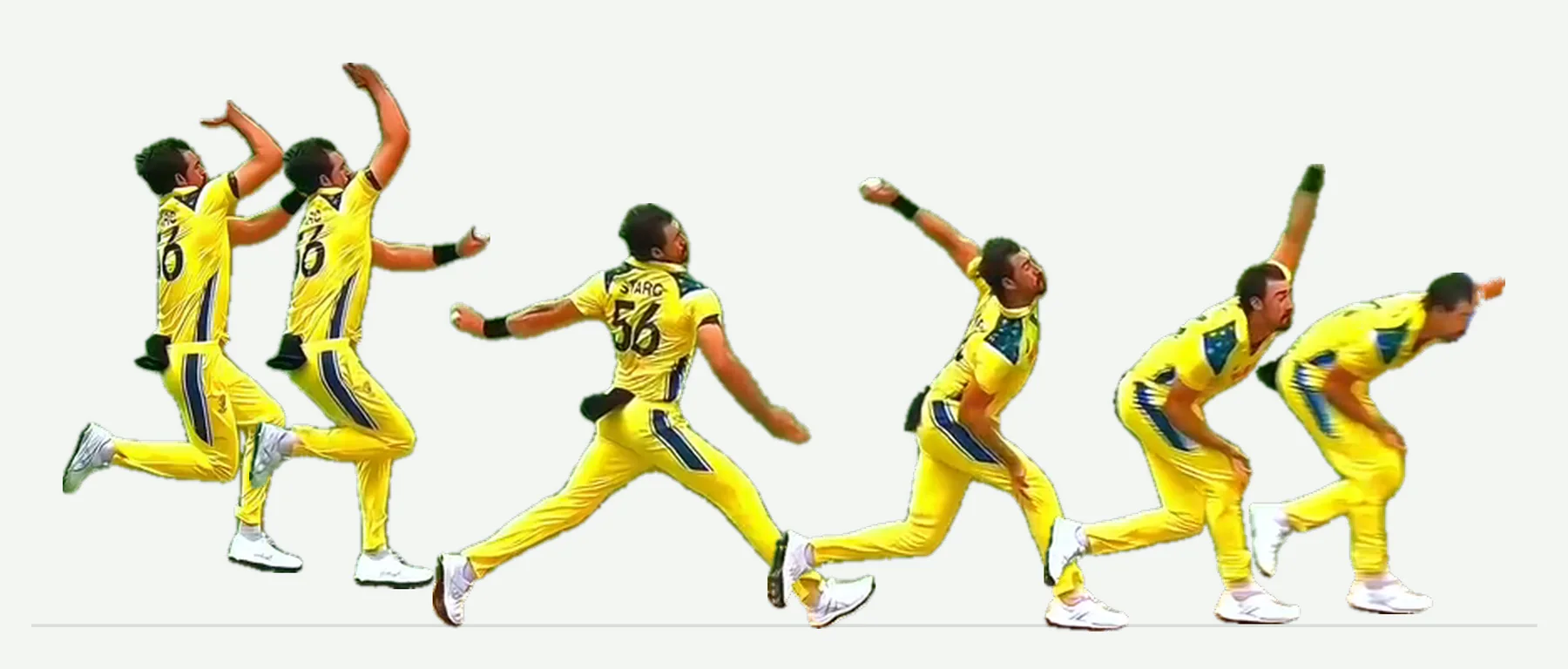
The six moments, bowler by bowler
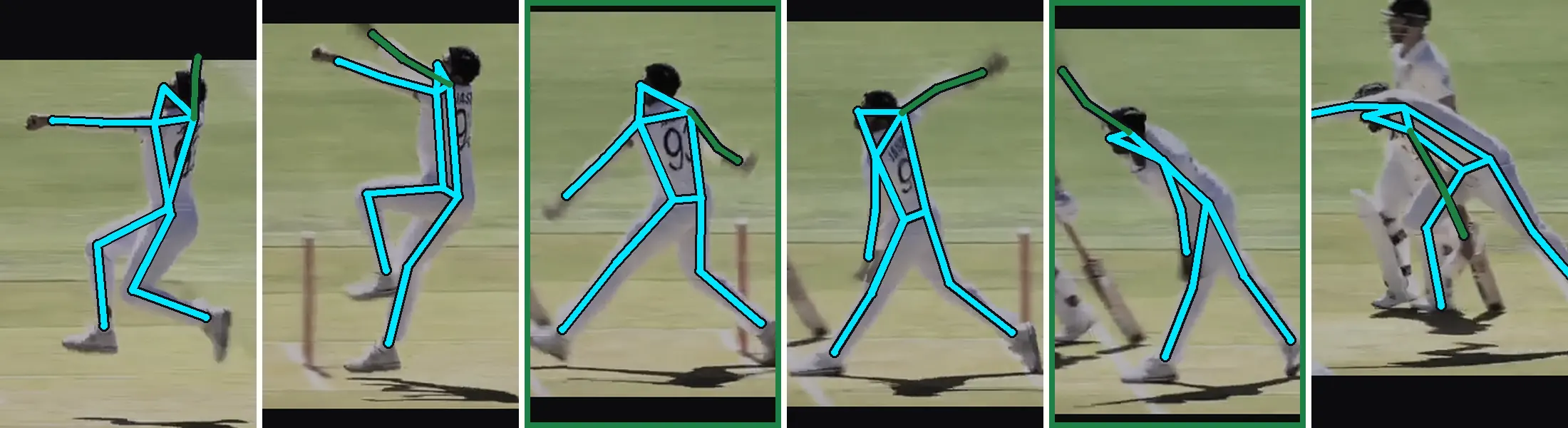
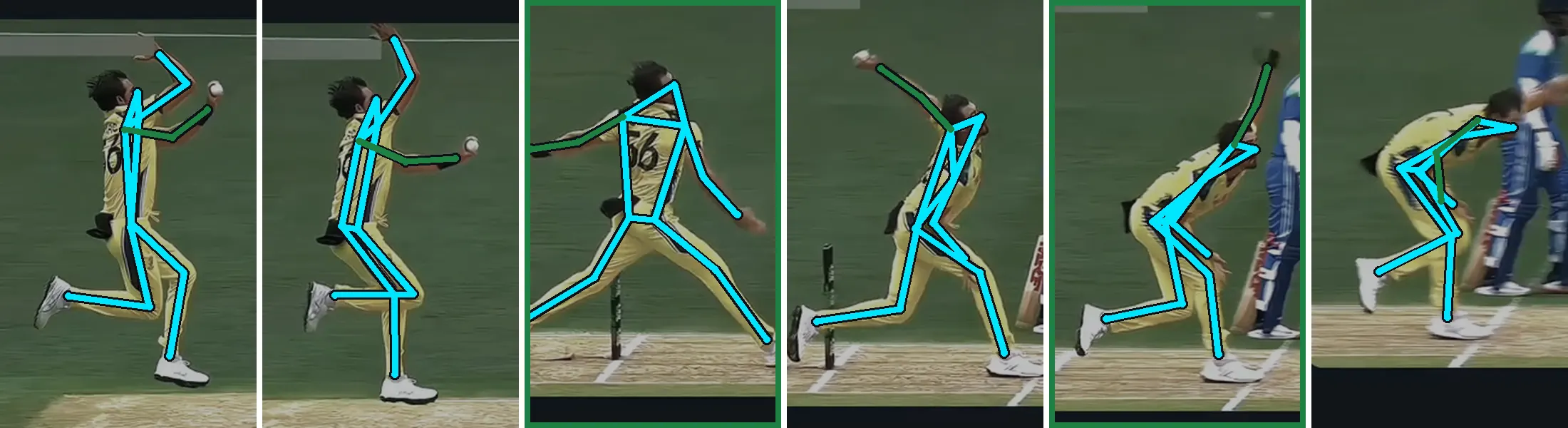
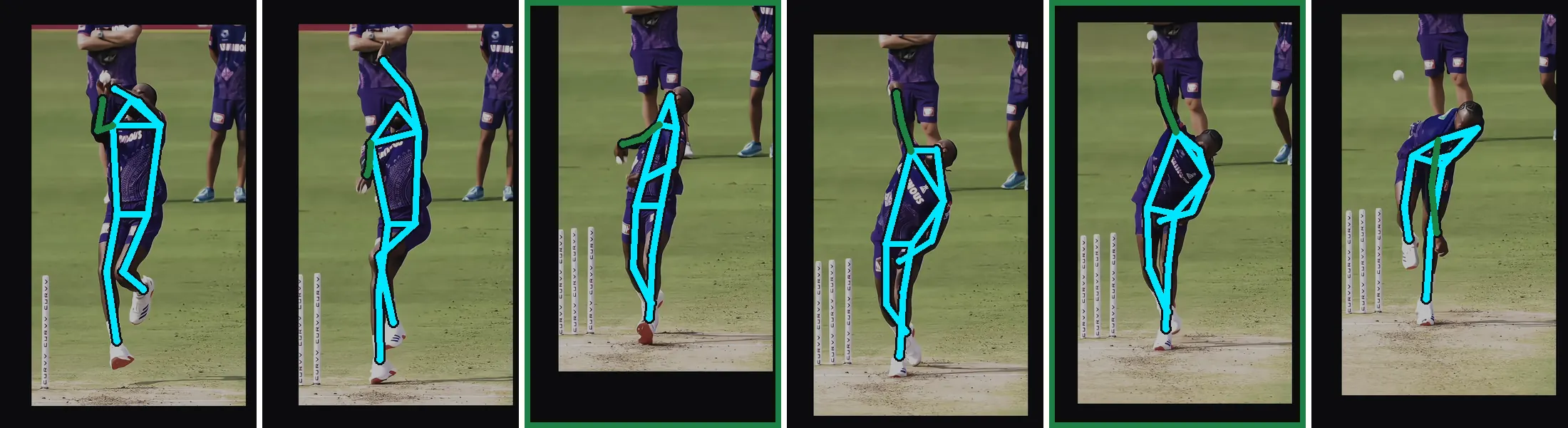
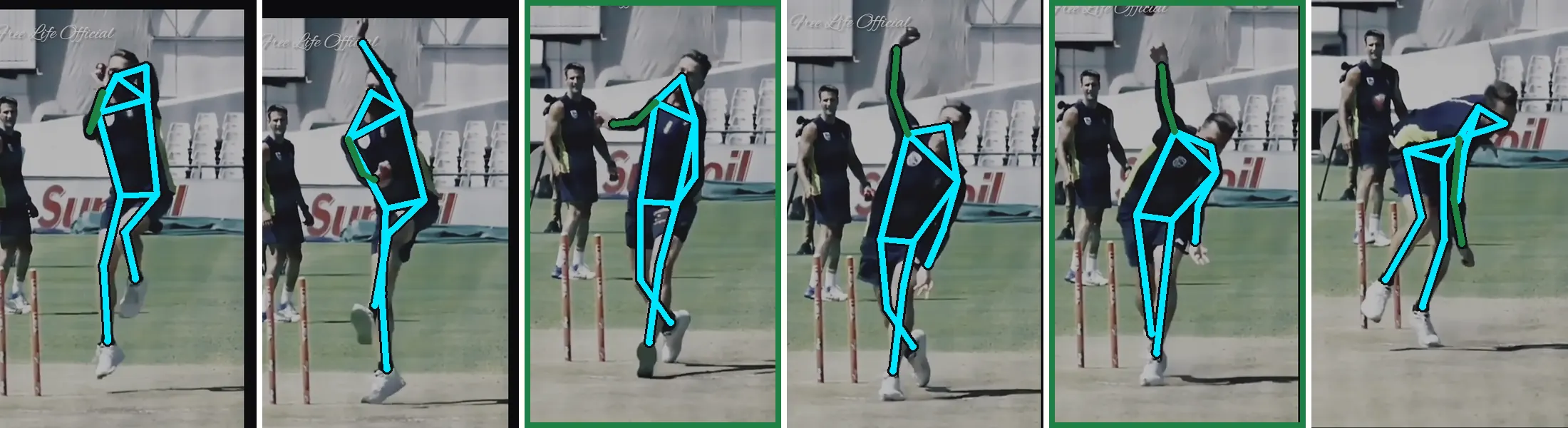
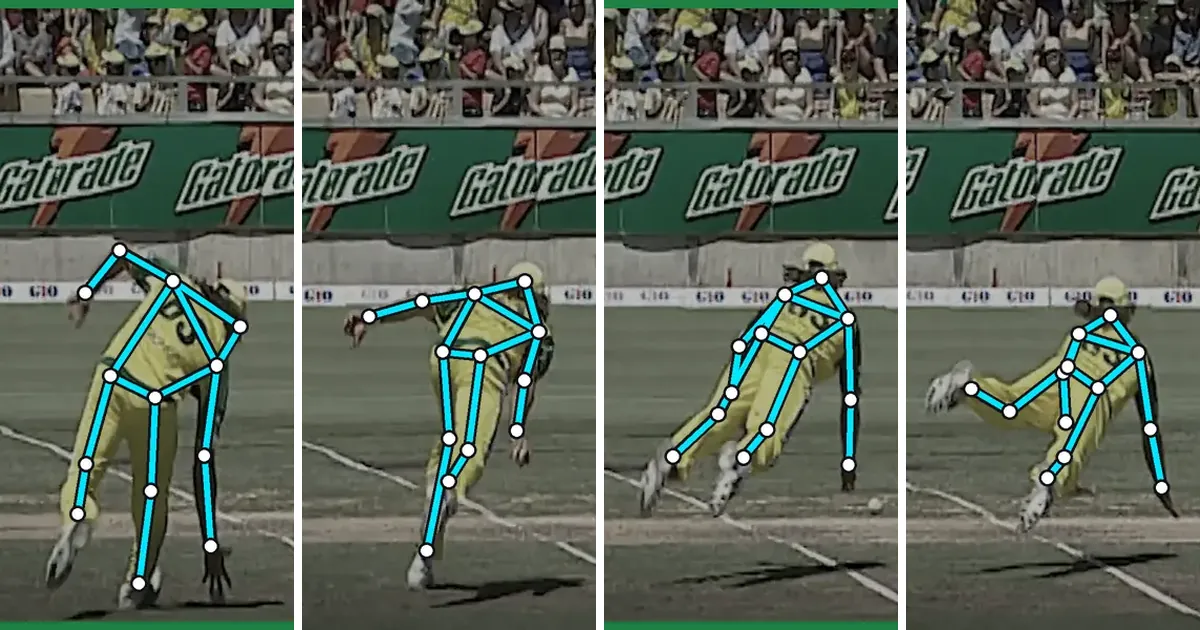
Each strip below is one delivery, cropped around the bowler. The green frames are the two moments a coach looks at first: front-foot contact and release. On a phone, swipe a strip sideways to see all six frames.
- Bound
- Back-foot contact
- Front-foot contact
- Arm coming over
- Release
- Follow-through
- Bound
- Back-foot contact
- Front-foot contact
- Arm coming over
- Release
- Follow-through
- Bound
- Back-foot contact
- Front-foot contact
- Arm coming over
- Around release
- Follow-through
- Bound
- Back-foot contact
- Front-foot contact
- Arm coming over
- Release
- Follow-through
Put the two side-on strips together and the actions look nothing alike. Bumrah’s bound is short, with both arms spread wide. Starc’s gather is longer and more flowing. Yet at front-foot contact both have the front arm out towards the batter and the bowling arm back behind them, about to come over. Different routes, a shared middle.
From in front, Archer and Steyn show what side-on hides: how the bowler lines up with the stumps, and how close to the head the bowling arm comes over.
What the front leg does
Between front-foot contact and release, the front leg can stay firm while the body goes over it (coaches call that a braced front leg), give a little (softens), or fold as the body sinks into it (bends). You can see which side-on without a single number.
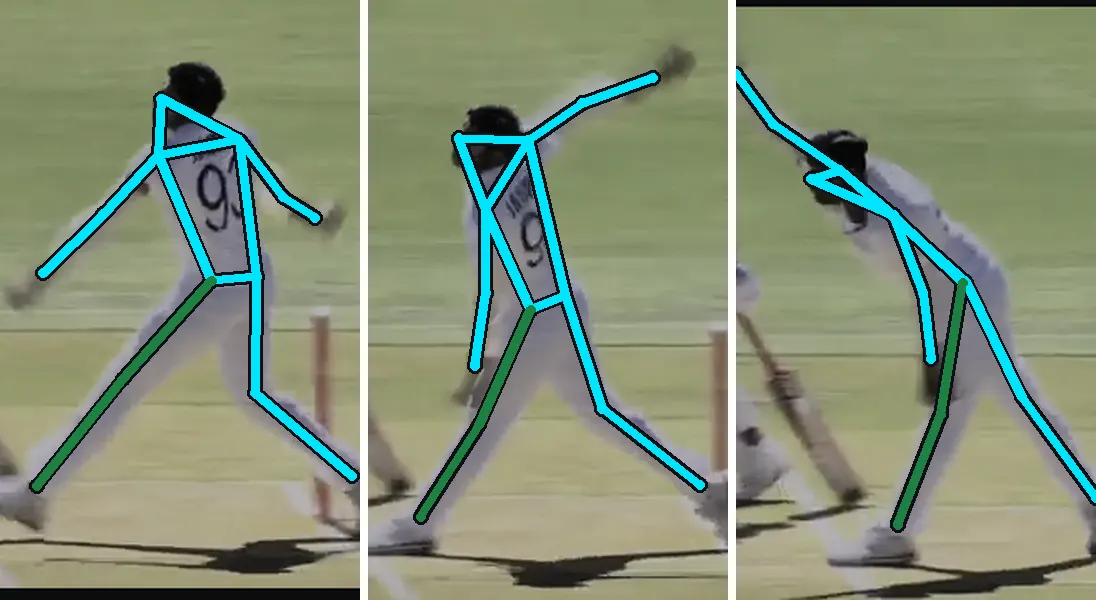
Bumrah: softens.
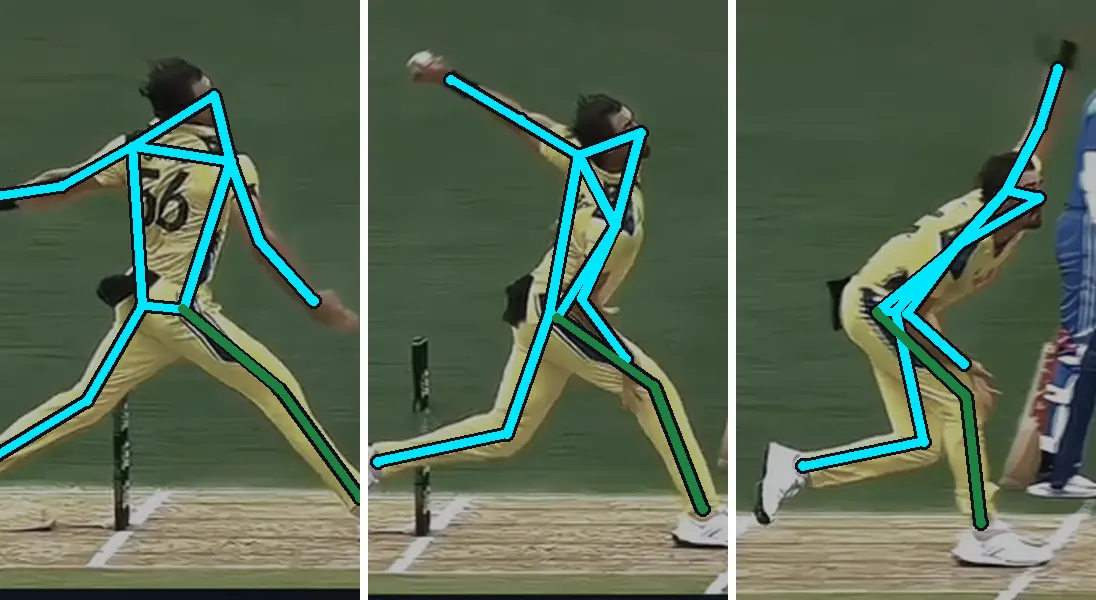
Starc: bends.
Neither is “right”. A braced front leg is common among the quickest bowlers, and a softer one is common too. What matters for a coach is whether a bowler does the same thing ball after ball, and whether it changes when they’re tired.
The two front-on clips get no front-leg read at all. From in front, a straight leg and a bent one can look the same, so the honest answer is “needs a side-on camera”.
Release
At the 25 to 30 frames a second of most of these clips, the ball leaves the hand somewhere between two frames. So we never point at one “release frame”. We mark release where it can be seen, say so where it can’t, and say how often the wrist was found.
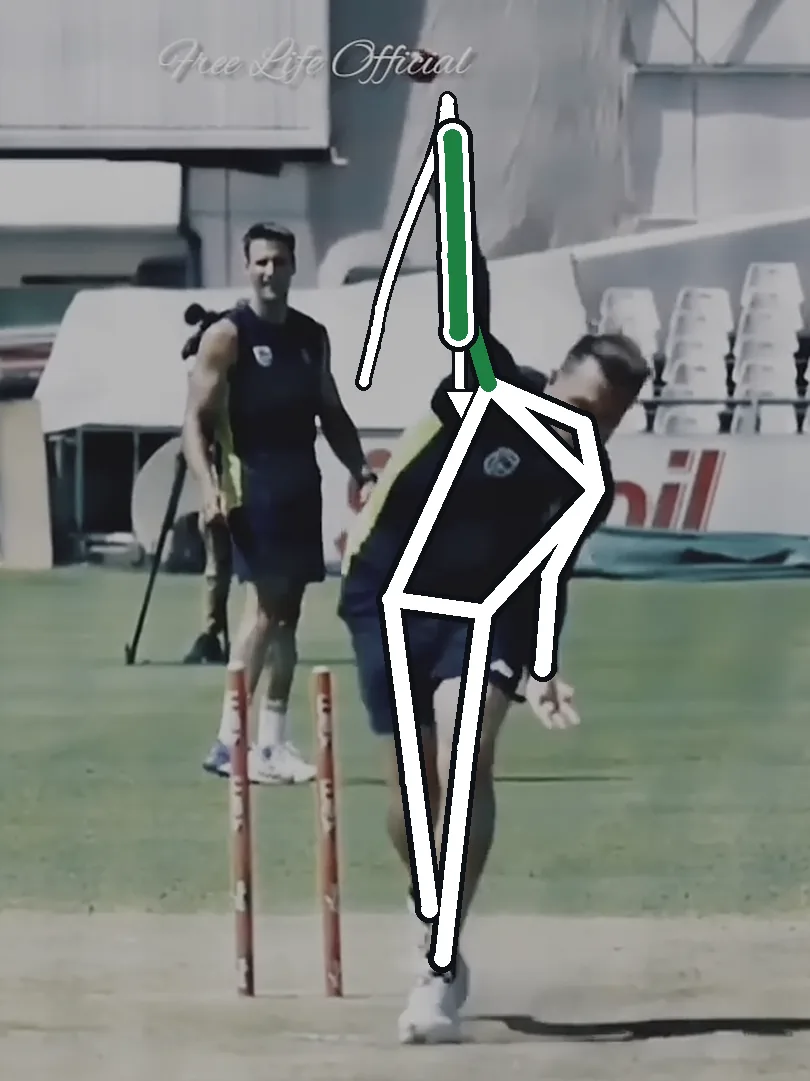
Steyn. The bowling wrist's path from front-foot contact to just after release, smoothed, with the release as a short green stroke. Wrist found in 29 of 29 frames around release. Footage: Free Life Official, social clip.
Archer. No release picture: in his clip the hand goes above the top of the frame at release, so there is nothing to mark.
Front-on is the best view of the arm: it shows whether the bowling arm comes over close to the head or wider of it. In both side-on clips here the camera sits on the far side from the bowling arm, so the arm is hidden behind the body for part of the action. A lighter pose model lost Bumrah's bowling elbow in most frames; a heavier one found his bowling wrist in 15 of 18 frames around release, and Starc's in 192 of 259.
Where the hand comes over, delivery after delivery
The long end-on clips can’t show the action in detail, but they show something a single side-on clip can’t: the same bowler, ball after ball, from the same camera. For every live delivery we took the frame where the bowling wrist was highest and marked the wrist, relative to the bowler’s own body.
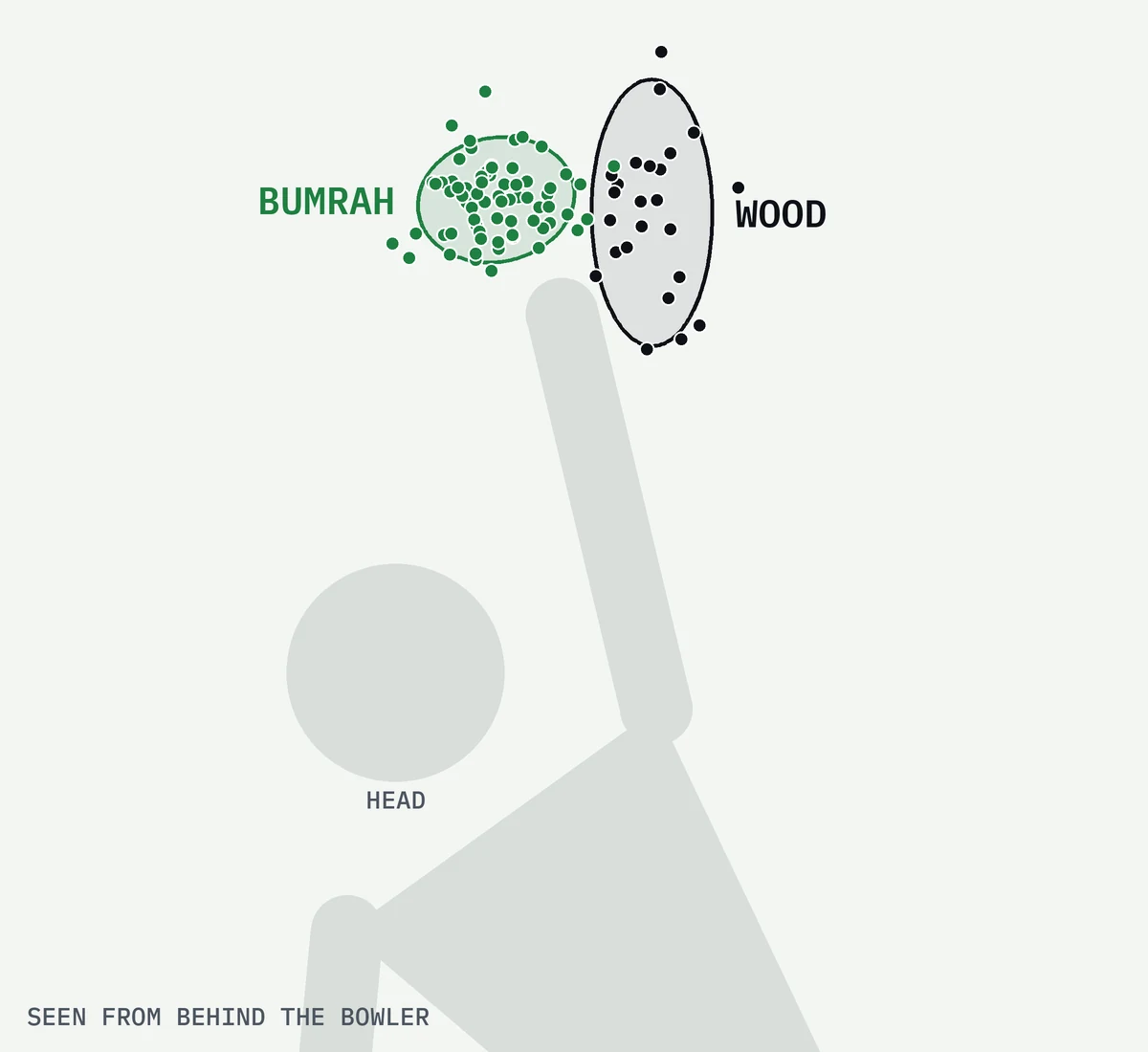
Bumrah (green): 71 of 71 live deliveries. The hand comes over almost on top of his head as he leans away, in a tight, round cluster.
Wood (black): 24 of 24 live deliveries. The hand comes over wider of his head, above the bowling shoulder, in a cluster taller than it is wide.
What a coach would look for in a picture like this isn’t where the dots sit but how tightly they gather. A bowler whose hand arrives in the same place ball after ball has a repeatable action.
Where the ball landed
The two long clips are end-on match highlights, filmed from behind the bowler. They show where each delivery pitched, roughly. For each live delivery our software marked a landing zone from the broadcast picture, the way a coach would tag it at the nets: full, good or short, and off, middle or leg relative to the batter.
Bumrah
Bumrah: 48 of 68 good length on off; 8 of 68 good length on middle; every other zone too few to show.
68 deliveries · Full 6 · Good 58 · Short 4
Off 53 · Middle 12 · Leg 3
Wood
Wood: 15 of 24 good length on off; 5 of 24 good length on middle; every other zone too few to show.
24 deliveries · Full 1 · Good 20 · Short 3
Off 17 · Middle 7 · Leg 0
Both bowlers lived on a good length on off, the channel that makes a batter play and miss or edge. That’s the Test-match plan, and the grids show it in a way any club player understands. The length calls are the least certain part: at broadcast resolution the ball is a few pixels across when it lands.
What a camera can’t tell you
Bumrah’s bowling arm is often described as hyperextending: at the top of the action the elbow seems to bend slightly backwards past straight. Replays of it get argued about every summer.
This is exactly where one camera stops being useful. An elbow isn’t a hinge sitting flat to the lens. The upper arm rotates, the forearm naturally angles away from it, and the whole arm swings through three dimensions in a fraction of a second. Film the same arm from a different angle and its bend on screen changes, even when the elbow hasn’t moved at all.
That’s why the ICC tests a suspect action in an accredited laboratory, with markers on the arm and many cameras around the bowler, not from match footage.
So BatSwing never calls an action legal or illegal, never flags hyperextension and never gives an elbow angle. If you’re worried about a bowler’s action, the route is a qualified coach and, if needed, a proper laboratory assessment.
What a coach would take from this
- Read the moments, not the numbersFront-foot contact and release are the two frames to look at first. A side-on phone sees them without a single angle.
- Same thing, ball after ballBraced, softening or bending: no front leg is "right". What matters is whether a bowler repeats it, and whether it changes when they tire.
- Know what a camera can't tell youOne camera can't judge an elbow. Legality is a laboratory question, never a phone's.
What this means at an academy
None of this needs a broadcast camera. One phone on a tripod, side-on from the bowling-arm side, sees the moments, the front leg, the head and the follow-through. A second phone behind the bowler sees where the ball lands.
We’re building that for academy nets sessions: the key moments proposed for the coach to confirm, the front leg read in words, coach-tagged landing zones, and a recorded count of balls bowled. It isn’t in the product yet. Until it is, the breakdown above is the vocabulary; the coach is still the one who calls it.
Sources
- End-on footage: ECB official highlights (Jasprit Bumrah, England v India; Mark Wood, England v Australia). Side-on footage: broadcast replays of Australia v India matches (Bumrah in a Test; Mitchell Starc in a white-ball match). Front-on footage: social clips of nets sessions (Jofra Archer; Dale Steyn, published by Free Life Official). Short derived stills and one short excerpt, hosted by BatSwing for technical commentary; all rights remain with the rights holders.
- ICC regulations for the review of bowlers reported with suspected illegal bowling actions: icc-cricket.com.
- Felton and King (2016), the effect of elbow hyperextension on ball speed in fast bowling: Loughborough University repository.
- Front-foot contact in fast bowling, Felton et al.: Nottingham Trent repository.
This is an independent technical analysis produced by BatSwing for editorial and commentary purposes. It is not an official assessment, endorsement or ranking, and is not affiliated with or endorsed by the players, their management, any board, any team or any broadcaster. Skeletons, traces and strips are derived illustrations made from short excerpts of publicly broadcast footage for critical commentary; all rights remain with the rights holders. Takedown requests can be sent to [CONTACT EMAIL] and are actioned within 24 hours.
Want to see what BatSwing does with an academy session?
These breakdowns are made by hand from broadcast footage. BatSwing itself is different: one phone at your nets, a ball sheet your coach confirms, and progress your players can see.
Book a demo →