What one phone can see, and what it can't.
A wrong number in front of a player costs a coach more than no number at all. So BatSwing shows a number only where it can stand behind it. Today that means your coach's own counts. Everything else is words, a replay you can check by eye, or nothing.
The numbers you will see are counts, not measurements.
Control comes from the coach's taps, not from a model. It always carries its denominator, so a good evening of seven balls can't pass for a good month.
15 of 20
attempted balls in control. Middled counts as in control. Leaves are counted separately, and balls the coach hasn't confirmed don't count either way.
Trend, or not yet
An arrow appears only when the evidence is strong enough. Otherwise BatSwing says "not enough data", "change not yet clear" or "withheld". The rules are on Features.
No angles
No joint angles, speeds or distances, on any screen or report. One camera has no depth, so any such number would be a guess dressed up as a measurement.
One side-on phone, and what a second phone adds.
One side-on phone
- Ball splitting from one continuous recording, which the coach reviews and corrects
- The coach's ball sheet, control with its denominator, and progress across sessions
- 2.5D replays: cut-outs of the real frames, layered so the picture moves a little as it plays, like a pop-up book. Labelled "2.5D replay from one camera. Not a 3D measurement."
Knee bend can't be seen side-on: the front knee bends towards the camera, so we don't show it.
Add a front-on phone Pilot
- Synced two-angle playback of each ball, lined up by the sound of bat on ball
Pilot feature. Sync thresholds are not yet validated on real footage. Knees, elbows, stride and backlift stay hidden even with two phones.
What BatSwing doesn't do today.
- Knee or elbow angles
- Stride or backlift numbers
- Measured bat path, bat speed or ball speed
- Line and length
- Automatic detection of what was bowled
- Full 3D from one camera (the coming 3D estimate is a preview, not a measurement)
- Automatically scored control
Where the computer can be wrong, and who catches it.
- Ball splitting
- BatSwing listens for bat on ball and watches the downswing to cut the recording into balls. It can miss a ball or find a false one, so the coach reviews the detected balls, drops a false one or adds a missed one.
- Outcome suggestions
- A suggestion like "bat-on-ball sound heard" never counts on its own. Nothing reaches a chart until the coach taps an outcome. Tap again to correct it; the latest call wins.
- Replay trails
- Replays draw the bat's path as a shape to look at, from one camera, never as a measurement or a number. The bat is detected automatically and left out when the detector isn't sure, rather than guessed, so a trail stops where tracking was unsure.
- Automatic scoring
- Not switched on. It needs around a thousand coach-labelled balls from several academies to test against, and we'll only switch it on if it's right nearly every time, and say how often it is.
A simulation, not real footage. Yet.
Our pose tests so far use rendered batters, where the true position of every joint is known exactly. That tells us which body parts the tracker follows closely on the video and which it loses, and it's why we hide what we hide.
Close on the video is not the same as measured. A joint can sit in the right place on the flat image and still give a wrong angle, because one camera can't see depth. That's why even the steadiest joints don't become numbers.
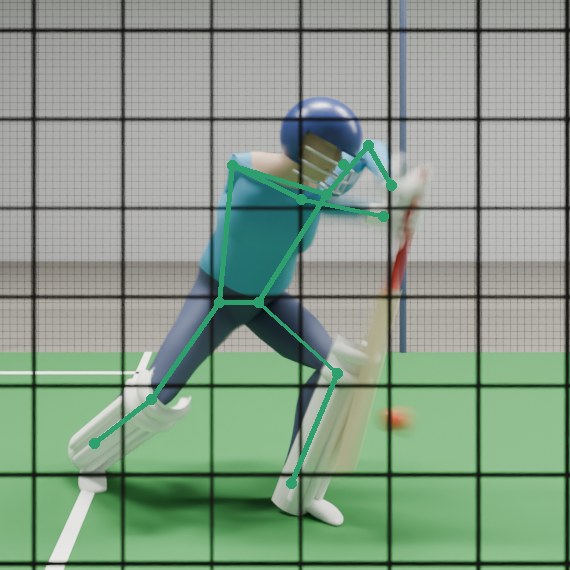
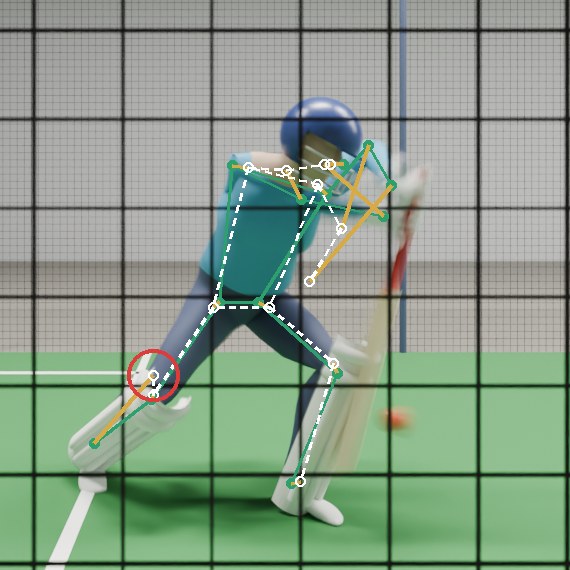
What the latest round covered, and what comes next.
Simulation results are internal and we don't quote them as proof. The latest round rendered 36 side and front clip pairs: cover drives and back-foot defences, three body sizes, the side phone moved between 1.9 and 2.8 metres away and 0.75 to 1.35 metres high, some clips in dim light or without a net, and some with phone compression or a shaky hand. It is still rendered footage. Real nets are harder.
Real-footage checks come from pilot sessions. When we have them we'll publish them here, with their error bands, before any number reaches a player.
Ask us anything about this page.
We'd rather you hear the limits from us than find them in a session.
Book a demo →